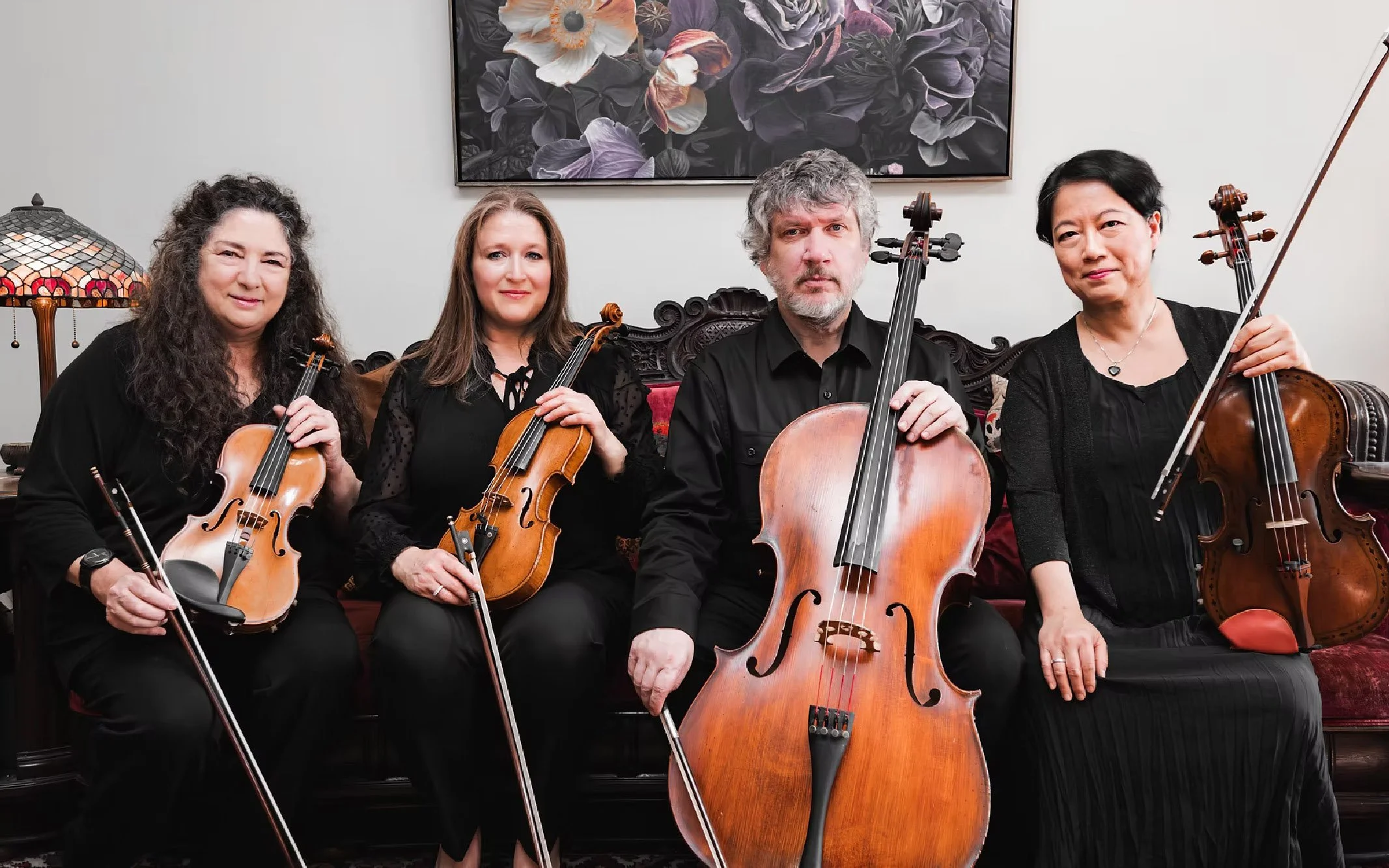
In celebration of the United States semiquincentennial, DAHA presents a concert of Antonín Dvořák’s renowned chamber works written while visiting Spillville, Iowa in the summer of 1893 – the Op. 96 “American” Quartet and the Op. 97 String Quintet.
Performed by the esteemed Sullivan Quartet and featuring a pre-concert talk by musicologist David Catchpole, the concert is part of Dvořák: The Chamber Music Survey, our multi-year survey of Dvořák’s chamber works exploring his development as a composer for small ensemble, organized by DAHA music advisor and violinist, Laura Jean Goldberg.
The concert and talk will introduce audiences to elements of Dvořák’s American style and his engagement with the aural landscape of the United States. Replete with sonic invocations of American countryside, rail travel, and other musical impressions, Dvořák’s Op. 96 and Op. 97 evocatively express his ideas of musical Americanism as coalesced during his remarkably productive 100 days in Spillville.
Program
Dvořák, String Quartet in F Major, Opus 96, the "American", c.1893
Dvořák, String Quintet in E-flat Major, Opus 97, the "American", c.1893
The Sullivan String Quartet: Laura Jean Goldberg, Violin I, Anat Malkin, Violin II, Liuh-Wen Ting, Viola, Robert La Rue, Cello, with guest artist Louise Schulman, Viola.
General admission: $30; seniors, students: $20. Tickets may be purchased online through Eventbrite or at the door at the time of the event (cash only).
Ticket sales only cover a portion of the programs produced by the Dvořák American Heritage Association, which celebrates its 20th year of public concerts and lectures in 2026. Please consider making a contribution to DAHA.
About
The concert will be preceded by a talk by David Catchpole on Antonín Dvořák’s American works, introducing the audience to key musical moments and historical context, and discuss his impact on American music at America’s 250th through an examination of his ideas on musical nationalism, his own compositions, and those of his students. Dvořák’s pronouncements on American music and his work as a teacher during his three-year tenure at the National Conservatory of Music of America furthered an inclusive idea of American music.
Both at the National Conservatory and at the Prague Conservatory after he returned to Europe, he taught a generation of musicians who would shape American musical culture for much of the twentieth century, such as Harry T. Burleigh, William Marion Cook, and Rubin Goldmark, among others. Dvořák’s embrace of diversity and call to look for America’s music at the margins provides an opportunity to examine how ideas of belonging and identity shaped the creation and reception of music by American composers throughout the twentieth and into the twenty-first centuries.
The SULLIVAN STRING QUARTET brings together Laura Jean Goldberg, violin I, Anat Malkin, violin II, Liuh-Wen Ting, viola, and Robert La Rue, cello. Each member of the ensemble has a wide-ranging and impressive career in the chamber music scene. The Sullivan Quartet has performed recitals at Bohemian National Hall, Merkin Hall at Kaufman Music Center, the Arion Chamber Music Series, Bargemusic in NYC, and at "Music at the Museum" in Bennington, VT. The quartet's inclusive multicultural approach gives a place of honor to repertoire by women composers, African American, Hispanic, and Asian composers, as well as the traditional string quartet repertoire. The Sullivan Quartet is named after trailblazing American architect Louis H. Sullivan, the founder of the "Chicago School" of architecture. Sullivan designed buildings with innovative steel-frame construction that incorporated elements of Art Nouveau and Arts and Crafts style ornamentation.
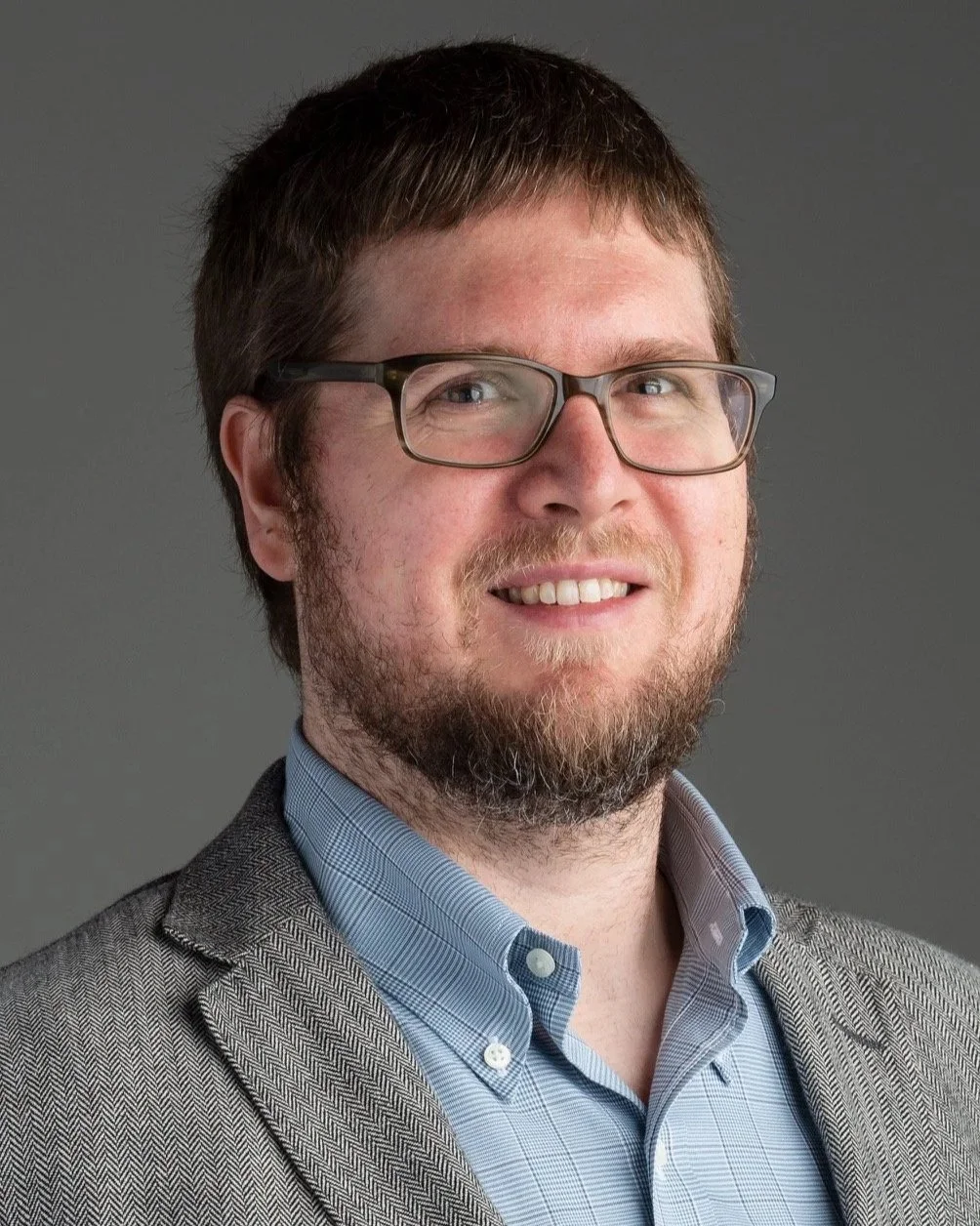
DAVID CATCHPOLE is a lecturer in Musicology at Texas State University and a Trustee on the board of the Dvořák American Heritage Association. David’s current research focuses on the role of symphonic radio broadcasts in shaping ideas of citizenship and belonging in the United States during the first half of the twentieth century. He has written program notes for the BBC Proms and Austin Cantorum and presented his work at conferences across the United States and internationally, including the American Musicological Society, Society for American Music, and German Studies Association annual meetings. The topics he works on encompass a range of areas, including radio, music and identity formation, twentieth-century opera, Habsburg culture and music around the fin-de-siècle, and Czech-American musical culture in the early twentieth century. His research has been supported by a travel subvention from the American Musicological Society and a Margery Lowens Dissertation Research Fellowship from the Society for American Music.

Violinist LAURA JEAN GOLDBERG is active as performer, teacher, and presenter for musicians and artists both in the US and abroad. As a solo violinist, she performed with the BSO at Boston's Symphony Hall and played recitals in Boston, New York, and in India. A member of the chamber music faculty at The Juilliard School Pre-college division, she previously taught at Columbia University, Yale, and Teachers College. She has performed at Weill Recital Hall at Carnegie Hall, Alice Tully Hall, Tanglewood, venues in India, Japan, London, Paris, and across the US. As founding member of the Cassatt Quartet, Goldberg earned top prizes at the Fischoff, Coleman, and Banff competitions and worked as assistant to the Juilliard and Tokyo Quartets. Goldberg recently rejoined the Cassatt Quartet after several years, currently concertizing and teaching with this ensemble. She is committed to celebrating the music of living composers including Julia Wolfe, Moshe Knoll, Eric Ewazen, Behzad Ranjbaran, Daniel Strong Godfrey, and Gabriela Lena Frank. Goldberg is a founding member of the Sullivan String Quartet, based in New York, often performing music by Antonín Dvořák at DAHA events. Trained at The Juilliard School with Lewis Kaplan and with Charles Castleman at the Castleman Quartet Program, Goldberg is the founder of ArtsAhimsa Music for Peace, presenting events that inspire and support inclusive communities, social justice, and the environment through the arts. She teaches and is the director at Belvoir Terrace camp for girls and is a board member at DAHA.
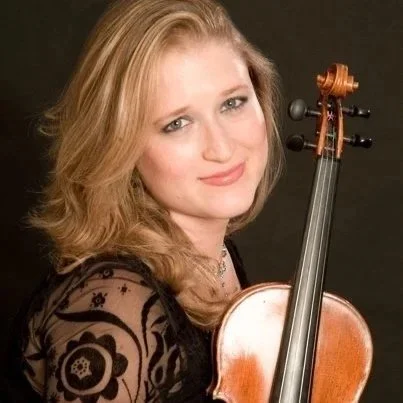
A versatile artist, violinist and violist ANAT MALKIN has performed as soloist, recitalist and chamber musician around the world. She embarked on her first international tour at the age of 10, and made her Carnegie Hall debut under the baton of Alexander Schneider at age sixteen. Some of the orchestras with whom she has soloed internationally include the Camerata Universidad Andrés Bello (Chile), Drammen Byorkester (Norway), Israel Chamber Orchestra, New York String Orchestra, Orquesta Filarmonica de Bogotá (Colombia), Orquesta Sinfonica de Salta (Argentina) and the Westchester Philharmonic. Performance broadcasts, interviews and articles about her have appeared in Asian, European, North and South American programs and press. An avid chamber musician and frequent guest artist, Ms. Malkin is presently a member of the New York-based Piazzolla Trio. She is also a founding member of the prizewinning Malkin Duo. She is a graduate of the Juilliard School and the Maastricht Conservatorium, cum laude. On the artist faculty at various international music festivals, Ms. Malkin serves on the violin and viola faculties of the Manhattan School of Music Precollege Division, and is an artist-in-residence at Temple University.

Violist LIUH-WEN TING enjoys a diverse career as an accomplished performer and dedicated educator. A Juilliard graduate with both bachelor’s and master’s degrees, she also holds a doctorate from Stony Brook University. Dr. Ting serves on the viola faculty at Vassar College and the Mannes School of Music preparatory division. As a seasoned chamber musician, she was a member of the award-winning Meridian String Quartet and currently performs with the Sullivan Quartet. She has collaborated with numerous distinguished artists and appeared as a guest performer with a wide array of ensembles. Additionally, she is a long-time member of the Orchestra of St. Luke’s, the American Composers Orchestra, and the SEM, ISCM, and Berkshire Bach Ensembles. Driven by a deep commitment to contemporary repertoire, Liuh-Wen made her Merkin Hall debut in 2001 with a recital featuring five commissioned works inspired by the I Ching. That same year, her performance of Morton Feldman’s The Viola in My Life IV with the Janáček Philharmonic Orchestra was hailed by Czech Music 2001 as "an extraordinary experience." For over two decades, she has been a performing staff member of the Composers Conference. She has also appeared at major international festivals, including Prague Spring, Warsaw Autumn, Ostrava Days, and Havana’s Primavera en la Habana. A versatile performer, she has commissioned and premiered many new works, and her chamber and solo discography spans prestigious labels such as Mode, Naxos, Atlantic, and Tzadik.

ROBERT LA RUE, cello, was First Prize Winner of the National Society of Arts and Letters Cello Competition, whose jury chairman was Mstislav Rostropovich. Formerly the cellist of the New England String Quartet, Robert is a current member of the Sullivan String Quartet, the Alcott Trio, and the cello ensemble VC3. He plays regularly with the Phoenix Chamber Players at Manhattan’s Center for Jewish History, and has also been a guest of the Locrian Chamber Players and the Alaria Ensemble. He has performed as soloist with the Banff Festival Orchestra, the American Symphony Orchestra, and orchestras in Seattle, Phoenix, and Denver. He has served as visiting faculty at Yale University’s Summer Music School and has taught cello at Rutgers University. He has recorded for Arsis Audio and North Branch Records, and is currently completing a disc of works for solo cello by members of the American Composers Alliance. A graduate of Curtis, New England Conservatory, and Juilliard, he also attended Indiana University. His teachers included David Soyer, Bernard Greenhouse, Janos Starker, and Tsuyoshi Tsutsumi.
Since 1970, violist LOUISE SCHULMAN has been widely recognized as one of New York's most dedicated, versatile, and gifted instrumentalists. She is a founding member [1974] and principal viola of the St. Lukes Chamber Ensemble and Orchestra of St. Lukes, performing in virtually all of the group's acclaimed concerts and recordings. During her student days, she studied string quartet playing with the Budapest Quartet and the Hungarian Quartet [1960s and 70s], and in the last several years she has mentored young string quartets both at Mannes and Manhattan School of Music. Ms. Schulman also has an affinity for early music, performing on a variety of stringed instruments including baroque viola and violin, vielle, cittern, and viola d'amore. Some of the groups she has performed and recorded with include the Waverly Consort, Philomel, Long Island Baroque Ensemble, Folger Consort, Breve, Clarion Concerts, New England Bach Festival, Ensemble for Early Music and Bacchanalia. Her solo recordings of Telemann and Vivaldi concerti [Music Masters and Essay labels] have won much praise from critics. Since 1975, she has been on the performing and coaching staff of the Composers Conference, performing and recording numerous chamber works of gifted young composers, and is the staff representative on the conference board of directors. Her recording of "Interviews" for viola and piano by Eleanor Cory is on CRI records. Ms. Schulman has performed many duo recitals with guitarist Bill Zito. The duo has recorded two CDs together: An Italian in Vienna, Music by Mauro Giuliani [Sono Luminus] and their second CD, Windows [Cambria Artists]. Her viola is by Zanetto da Montechiaro, ca. 1530.
This event is organized by DAHA with support of the Bohemian Benevolent and Literary Association. The program is supported by a grant from the Coalition of Music Organizations, a voluntary association that provides access to funding and mutual aid. The Coalition is an initiative of the American Musicological Society, a nonprofit organization dedicated to advancing our understanding of music.