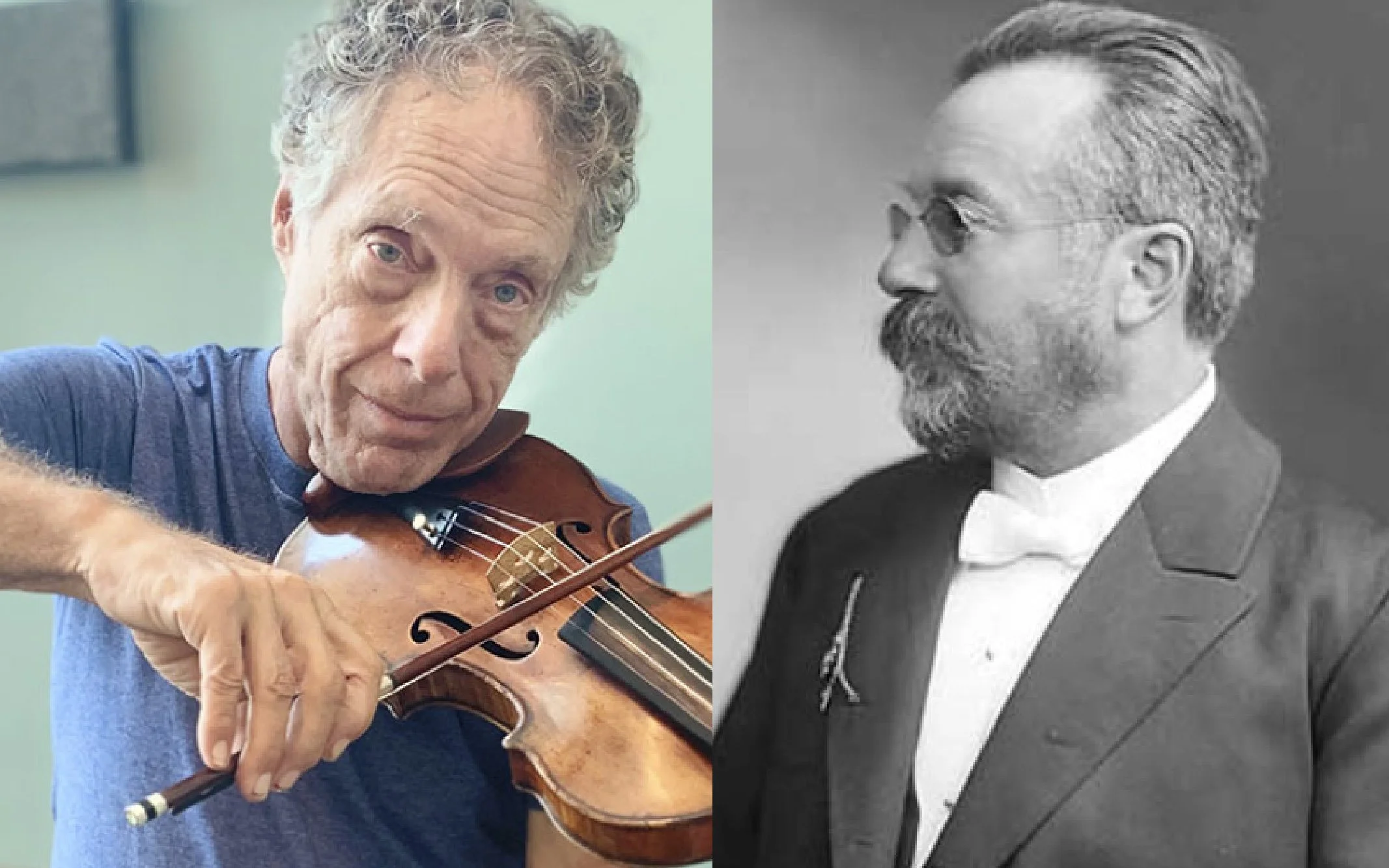
At this concert we celebrate virtuoso violinist and teacher Charles Castleman, living link to Czech master pedagogue Otakar Ševčík (1852-1934). Ševčík, renowned to this day as violinist and teacher, famously created his School of Violin Technique and Analytical Studies & Exercises, a method allowing string players to reach their potential in technical proficiency. Ševčík's teaching assistant, Emanuel Ondříček, was Charles Castleman's teacher when he was a young violinist. Castleman currently shares Ševčík's wealth of knowledge with his many students and thus carries the expressive and technical traditions of the Bohemian School of Violin Playing into the 21st century.
Dvořák American Heritage Association, with the support of the Bohemian Benevolent and Literary Association, is proud to share the music of Dvořák, Ondříček, Tchaikovsky, Mendelssohn, and Eugène Ysaÿe, who was Ševčík's friend and chamber music partner. In the beautiful venue of Bohemian National Hall in NYC, our audience will be treated to a multimedia presentation including live performance, historical recording, and even the experience of a violin lesson live on stage. We will learn why Ševčík's methods for violin, and string players generally, are powerful tools for achieving technical prowess and understand why musicians around the world continue to incorporate Ševčík's études into daily routines. This is an opportunity for music lovers to peek behind the veil of mystery surrounding the art of the violin, celebrate Charles Castleman and the lineage of generations of teachers and students.
Program
Dvořák, Humoresque No. 7, Opus 101 B. 187 for violin and piano
Bobby Boogyeom Park, violin, and Moshe Knoll, piano
Welcome statement: Laura Jean Goldberg and Charles Castleman
Video: Dvořák – Ondříček, Waltzes Opus 54 No.1 in A Major and No. 4 in D Major
Charles Castleman, violin, and Claudia Hoca, piano
Violin lesson: Ševčík Analytical Studies & Exercises with power point display
Charles Castleman and Bobby Boogyeom Park
Historical audio recording: Tchaikovsky, Excerpt of Violin Concerto in D Major Opus 35
Charles Castleman Violin, Final Round of the 1963 Brussels Competition
— intermission —
Ysaÿe, Sonata no. 2
1. Obsession; Prelude
2. Malinconia
3. Danse des Ombres; Saraband
4. Les furies
Charles Castleman, violin
Mendelssohn, Viola Quintet in A Major Opus 18
Allegro con motto
Intermezzo, Andante sostenuto
Scherzo, Allegro di molto
Allegro vivace
Charles Castleman, violin I, Laura Jean Goldberg, violin II, Liuh-Wen Ting, viola I, Laura Anne Bossert, viola II, Robert La Rue, cello
General admission: $30; seniors, students: $20. Tickets may be purchased online through Eventbrite or at the door at the time of the event (cash only).
The concert will be live streamed on YouTube, free of charge. Click here to join us online at the time of the event.
Ticket sales only cover a portion of the programs produced by the Dvořák American Heritage Association, which celebrates its 20th year of public concerts and lectures in 2026. Please consider making a contribution to DAHA.
About
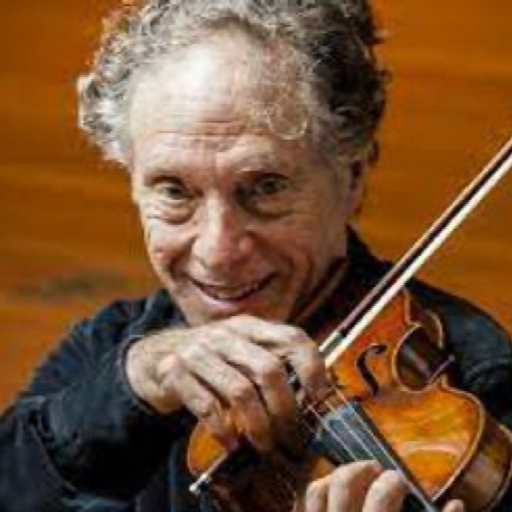
CHARLES CASTLEMAN (Founder, Director, Violin Teacher at the Castleman Quartet Program) – perhaps the world’s most active performer/pedagogue on the violin – has been soloist with the orchestras of Philadelphia, Boston, Brisbane, Chicago, Hong Kong, Moscow, Mexico City, New York, San Francisco, Seoul and Shanghai. Medalist at Tchaikovsky and Brussels, his Jongen Concerto is included in a Cypres CD set of the 17 best prize-winning performances of the Brussels Concours’ 50-year history.
Mr. Castleman’s solo CDs include Ysaye’s six Solo Sonatas (made at the time of his unique performance at Tully Hall in NYC), eight Hubay Csardases for Violin and Orchestra, and ten Sarasate virtuoso cameos on Music and Arts, Gershwin and Antheil on MusicMasters, and contemporary violin and harpsichord music for Albany. As one of sixteen Ford Foundation Concert Artists he commissioned the David Amram Concerto, premiering it with Leonard Slatkin and the St. Louis Symphony, recording it for Newport Classic. He is dedicatee of “Lares Hercii” by Pulitzer winner Christopher Rouse.
He has performed at such international festivals as Marlboro, Grant Park, Newport, Sarasota, AFCM (Australia), Budapest, Fuefukigawa, Montreux, Shanghai, Sheffield, and the Vienna Festwoche. He regularly participates in the Las Vegas, Park City, Round Top and Sitka festivals in the U.S. His recitals have been broadcast on NPR, BBC, in Berlin and in Paris.
Professor at the Frost School of Music, University of Miami, Mr. Castleman has conducted master-classes in London, Vienna, Helsinki, Kiev, Hong Kong, Shanghai, Seoul, Tokyo, and all major cities in Australia, Canada and New Zealand. His students have been winners at Brussels, Munich, Naumburg and Szeryng, are in 30 professionally active chamber groups and are 1st desk players in 11 major orchestras.
Charles Castleman’s long-term chamber music associations have included THE NEW STRING TRIO OF N.Y. with BASF recordings of Reger and Frank Martin; and THE RAPHAEL TRIO with CDs of Dvorak, Mendelssohn, Beethoven, and Wolf-Ferrari for NONESUCH, SONY CLASSICAL, DISCOVER, UNICORN, and ASV, and with premieres by Rainer Bischof and Frederic Rzewski for the Vienna Festival and Kennedy Center.
Mr. Castleman earned degrees from Harvard, Curtis, and University of Pennsylvania. His teachers were Emanuel Ondříček (teaching assistant of Ševčík, Ysaye student) and Ivan Galamian, and his most influential coaches David Oistrakh, Szeryng, and Gingold. He plays the “Marquis de Champeaux” Stradivarius from 1708, and chooses from 80 bows.
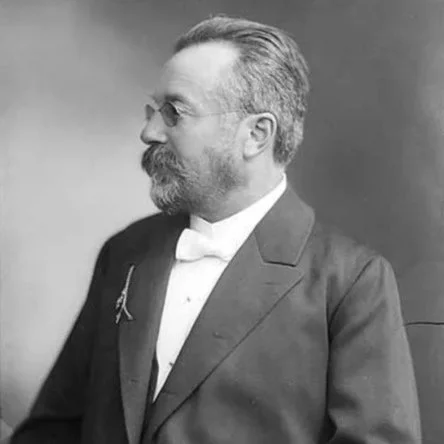
OTAKAR ŠEVČÍK (1852-1934) is renowned as a violinist, teacher, and the author of the Ševčík School of Violin Technique. Born in Bohemia, Ševčík was the son of the local school master, who was also a musician. Young Ševčík attended the Prague Conservatory where he studied violin with Antonin Bennewitz and Hans Sitt. Following conservatory, Ševčík held positions of concertmaster, teacher, and violin soloist at major venues and academies in Austria, Russia, and Bohemia including the Mozarteum Concerts in Salzburg, Prague Interim (Provisional) Theater, and professorship of violin at the Russian Music Society, Kyiv. During his years in Kyiv Ševčík began developing his famous Ševčík School of Violin Technique and (eventually) the Analytical Studies & Exercises, a transformative method for string players, enabling them to reach their potential in technical proficiency. Ševčík's method was based on analytical observation of skills necessary for mastering the violin, and composing a series of exercises for developing and honing these skills. Sevcik made a brilliant extrapolation based on observations of his father teaching language skills in the classroom: just as language fluency requires an understanding of grammar, so music needs a technical grammar to enable violinists to achieve fluency in their art. Ševčík's systematic method for the violin introduced a series of minute and specific technical actions, whether it be for the left hand or the bow, including repetitions of these technical actions from every possible position. Thus whatever techniques were required in a particular piece, all iterations would have been practiced in the method books. This is violin technique presented in its most abstract and efficient form.
Ševčík's Opus 1. School of Violin Technique, (published in 1881), Opus 2. School of Bowing Technique, (published 1894) Opus 3. 40 Variations, from the Violin Studies, (published in 1893), established his reputation as a leading pedagogue. During his career, Ševčík's catalogue of published works included a prodigious amount of technical exercise books, and several original compositions. He also composed a series of books of in-depth technical exercises titled Analytics, created specifically for the preparation of major violin concerti and virtuoso showpieces by composers including Tartini, Paganini, Vieuxtemps, Wieniawski, Ernst, Tchaikovsky, Bazzini, Brahms, and Mendelssohn.
The success of his School of Violin Technique brought Ševčík international acclaim in the field of music. After teaching in Kyiv for seventeen years, he was invited to take the position of professor at the Prague conservatory. Violin students from across Europe flocked to Prague hoping to study with the creator of the famous violin method. His students here included some of the brightest lights in the world of music: Jaroslav Kocián, Jan Kubelík, Emanuel Ondříček, Bohuslav Lhotský, Mary Hall, Erika Morini, Nora Duesberg, and others.
Antonín Dvořák was appointed director of the Prague Conservatory in 1901 and made Ševčík head of the violin department. By now Ševčík had achieved world renown as a pedagogue. Besides his knowledge of the violin, he also had a reputation as a caring and supportive teacher, advising students on their goals and musical development. Ševčík taught at the Imperial Royal Academy of Music in Vienna, established a "violin colony" in Pisek, Bohemia, and after WWI traveled to the US where he taught at Boston, New York, Chicago, Ithica, and in London.
In his last years Otakar Ševčík established the Ševčík College (Ševčíkova akademie). He founded the institution to train future generations of musicians in his special violin techniques, to provide support, and to provide a structured educational environment. The Ševčík Academy currently functions as a music festival and training school for musicians and music lovers of all ages.
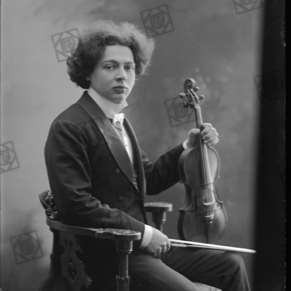
EMANUEL ONDŘÍČEK (1880 Plzeň - 1958 Boston) violinist, pedagogue and composer, was born into a family of talented Bohemian musicians. His grandfather Ignac Ondříček (1807 Krušovice -1871 Praha) was a violinist and conductor. His father Jan Ondříček, (1832 Běleč –1900 Praha) was a violinist, conductor, and teacher. Emanuel Ondříček was one of fifteen children, six of whom grew up to be professional musicians.
These musical siblings included Frantisek Ondříček (1857 Praha -1922 Milan), who performed the premier of Dvořák’s violin concerto, Karel Ondříček (1863 Praha - 1943 Boston), concertmaster of the National Theatre in Prague, performed at the Chicago World's Fair in 1893, and played second violin in the Kneisl Quartet, Marie Ondříčková (1863 Praha - 1943 Praha), Augusta Ondříčková (1879 Plzeň - 1952 New York), and Stanislav Ondříček (1885 Praha - 1953 Praha)
Emanuel Ondříček studied with Otakar Ševčík at the Prague Conservatory, and also held the position of Ševčík's Teaching Assistant. Ondříček achieved success as a celebrated concert violinist, performing in Russia, the Balkans and in many European capitals. In 1906 he performed in London under the pseudonym Floris, and in 1910 he followed the path of his brother Karel and emigrated to Boston MA.
Ondříček focused on pedagogy in 1912, founding the Ondricek Studios of Violin Art in Boston and New York. He was assisted by sisters Marie Ondříčková and Augusta Ondříčková and their husbands, who taught at the New York school. From September 1956 Ondříček was appointed Director of the Violin Department of the Master School at Boston University. Emanuel Ondříček, teaching assistant to Otakar Ševčík, was the teacher of Charles Castleman.
Violinist LAURA JEAN GOLDBERG is a performer, teacher, and concert organizer. As a solo violinist, Goldberg performed with the BSO at Boston's Symphony Hall and played recitals in Boston, New York, and in India. She is a member of the chamber music faculty at The Juilliard School Pre-college division and has performed at Weill Recital Hall, Carnegie Hall, Alice Tully Hall, Tanglewood, in Japan, London, Paris, and across the US. As founding member of the Cassatt Quartet, Goldberg earned top prizes at the Fischoff, Coleman, and Banff competitions and worked as assistant to the Juilliard and Tokyo Quartets. Goldberg recently rejoined the Cassatt as Violin II. She plays Violin I in the Sullivan Quartet, performing Dvorak's music at Dvorak American Heritage Association (DAHA), and violinist of the ArtsAhimsa Trio. Goldberg is committed to music of living composers including Julia Wolfe, Moshe Knoll, Eric Ewazen, Behzad Ranjbaran, and Gabriela Lena Frank. Trained at The Juilliard School and with Charles Castleman at the Castleman Quartet Program, Goldberg is founder of ArtsAhimsa, presenting events seeking to inspire peace through the arts. She teaches at camp Belvoir Terrace and is a board member at DAHA.
A graduate of the Juilliard School with BA and MA degrees and currently a DMA candidate at Stony Brook University, violist LIUH-WEN TING enjoys a fulfilling career as both a performer and teacher. An avid chamber musician, Liuh-Wen was a member of the Meridian String Quartet and has collaborated with many notable artists and ensembles across diverse genres. A proponent of contemporary music, she made her solo debut at Merkin Hall in 2001 for the "Interpretation Series" with five commissioned compositions based on elements of the I Ching. Her performance of Morton Feldman's "Viola in My Life IV" with the Janacek Philharmonic Orchestra was praised by Czech Music 2001 as “an extraordinary experience.” She has been featured in festivals such as the Prague Spring Music Festival, Ostrava Days, Warsaw Autumn Music Festival, and the Primavera en la Habana International Electro-Acoustic Music Festival in Cuba. She has premiered and recorded many chamber and solo works for labels including Naxos, Mode, Capstone, and Albany, among others. In New York, she performs regularly with the Orchestra of St. Luke's, the American Composers Orchestra, and the SEM Ensemble. She was on the Solfege faculty of the Juilliard Prep Division for many years and currently serves as a viola faculty member at the Mannes School Prep Division, as well as at Vassar College.
ROBERT LA RUE, cello, was First Prize Winner of the National Society of Arts and Letters Cello Competition, whose jury chairman was Mstislav Rostropovich. Formerly the cellist of the New England String Quartet, Robert is a current member of the Sullivan String Quartet, the Alcott Trio, and the cello ensemble VC3. He plays regularly with the Phoenix Chamber Players at Manhattan’s Center for Jewish History, and has also been a guest of the Locrian Chamber Players and the Alaria Ensemble. He has performed as soloist with the Banff Festival Orchestra, the American Symphony Orchestra and orchestras in Seattle, Phoenix and Denver. He has served as visiting faculty at Yale University’s Summer Music School and has taught cello at Rutgers University. He has recorded for Arsis Audio and North Branch Records, and is currently completing a disc of works for solo cello by members of the American Composers Alliance. A graduate of Curtis, New England Conservatory, and Juilliard, he also attended Indiana University. His teachers included include David Soyer, Bernard Greenhouse, Janos Starker and Tsuyoshi Tsutsumi.
LAURA ANNE BOSSERT violinist/violist, a Silver Medalist in the Henryk Szeryng International Violin Competition, has earned recognition for her artistry as a soloist, chamber musician, and pedagogue. She is one of the most respected and sought after teachers of her generation.
Ms. Bossert is a Senior Performance Faculty member of Wellesley College, a position she’s held for over a quarter of a century. She served as an Associate Professor of violin and viola at the Setnor School of Music at Syracuse University from 2016-2019 and during summers she is a faculty member of the Castleman Quartet Program, LyricaFest, ArtsAhimsa and the Wellesley Composer’s Conference. Her students hold positions in many wide ranging institutions including the San Francisco, National, Milwaukee, Toronto and Baltimore Symphonies, Handel and Haydn Society, Sante Fe Opera, A Far Cry, BBC Radio Orchestra, Helsinki, Santiago and Royal Philharmonics and the Hausmann & Cecilia String Quartets, (Banff’s 2010 International Quartet First prize winners). Bossert's students have received multiple grammy nominations and been awarded top prizes in international and national competitions such as Young Concert Artists, Fischoff, Spohr, Banff, Miami String Quartet Competition and the Music Teacher’s National Association (MTNA).
Ms. Bossert has appeared in collaboration with Elmar Oliveira, Joseph Silverstein, Paul Neubauer, Kim Kashkashian, David Jolley, Joseph Robinson and with ensembles such as the Shanghai, Muir, Invoke and Lark String Quartets and the Amelia, Raphael and Mirecourt Piano Trios. She toured as an improv violinist with David Amram and Chuck Mangione, and was a frequent guest artist with the Boston based ensemble Cello Chix. Ms. Bossert started her career as an orchestral player with the Utah Ballet Orchestra (Ballet West) and as guest concertmaster of the Tucson and Oklahoma Symphony Orchestras. Currently, she leads the Lyrica Chamber Orchestra.
Bossert resides in Lincoln, Massachusetts with her husband, cellist Terry King where they co-direct LyricaFest, a chamber music festival for college and conservatory students, now in its 26th season, and the Citizen’s Artist Orchestra which they founded in 2020 under the umbrella of Lyrica Boston Inc. a non for profit educational and outreach organization, in residence at the Boston Healthcare for the Homeless Program.
BOBBY BOOGYEOM PARK, violinist, is a sophomore at The Juilliard School studying violin with Itzhak Perlman and Catherine Cho under the Kovner Fellowship. Bobby also studied with Li Lin. He is a graduate of The Juilliard School Pre-College Division where he studied with Catherine Cho and Donald Weilerstein for seven years. Bobby attended the Perlman Music Program during summers 2022~24. Bobby has been a guest soloist at international concerts and festivals including Shanghai International Arts Festival at Oriental Art Center, Shanghai. He was a 1st prize winner at the International Russian Rotary Music Competition in Moscow and winner of the 2019 Juilliard Pre-College Concerto Competition. In 2021, at the age of 15, Bobby was the bronze medalist at the Stulberg International String Competition. In 2022, Bobby performed with Maxim Vengerov and the Oxford Philharmonic Orchestra in Stern Auditorium at Carnegie Hall. He has participated in festivals such as Four Seasons Chamber Music Festival and NUME Festival. In 2025 Bobby performed at Kronberg Academy Violin Masterclasses and worked with Mihaela Martin. Bobby was named one of four Rising Artists at the 2026 Rising Artists concert at The Chamber Music Society of Palm Beach, Florida. He has worked with distinguished pedagogues such as Maxim Vengerov, Gidon Kremer, Vadim Repin, Mihaela Martin, Ilya Kaler, Kyung Sun Lee and Joel Smirnoff. He has also collaborated on stage with artists such as Maxim Vengerov, Nicholas Kitchen, Ara Gregorian, Stella Chen, Tommaso Lonquich, Arnaud Sussmann, Edward Arron, and Marios Papadopoulos.
Pianist-composer MOSHE S. KNOLL was born in Venezuela of Eastern European immigrant parents. Educated at The Juilliard School and the University of Arizona, Knoll has a direct personal link to Antonín Dvořák: his mentor Ozan Marsh was a composition student of Rubin Goldmark, who was in turn a student of Dvořák, himself. Knoll has had a successful career as a pianist, pedagogue, composer, and arranger. His Piano Sonata #1 was published in 1980 and has been performed multiple times. In 1987 he received the Artist of the Year Award from the Pianist's Foundation of America. Recent achievements include his setting of Psalm 133 for Soprano, Narrator, and String Orchestra which has had repeated performances. ArtsAhimsa presented a Retrospective Concert of Knoll's works in NYC and he composed the soundtrack for the documentary film "God Knows Where I am" produced by Jedd and Todd Wider. His Chamber Cantata "Simplicity," set to texts by Henry David Thoreau, was premiered at Symphony Space by the Ark Trio in 2017, and it is included in their debut CD album, "Ark Resounding," which is now available on Amazon. His Piano Trio "Twilight Serenade" was performed at The Juilliard School in 2022, and in 2023 his composition “A Ballet for the New World” premiered at Bohemian National Hall, both with the composer at the piano. More than 80 of his compositions are published on Sheet Music Plus. Dr. Knoll has been Composer-in-Residence at ArtsAhimsa since 2012. He is also a member of the DAHA Board.
This event is organized by DAHA with support of the Bohemian Benevolent and Literary Association.